A companion blog site to the comunications studies course

Sunday, October 29, 2006

Four's a Crowd, but so is Three

In psychological terms, a crowd is not just a gathering of people, but rather a group of people who are working together for a cause, sacrificing their individual identity and opinions for more basic instincts and sentiments. (LeBon, 2006: 121)

This sounds like a very extreme case, one might think they are always in control of their identity. However, this is not an extreme case, nor is it a "case" at all. It is a constant in our species. Even if we are not forming a mob and setting things on fire, we are still under the constant influence of others.

For example, say you are at a restaurant, eating a burger. Someone behind you says "oh man, these burgers suck!". Even if you were enjoying your burger, you now have a tainted impression of it. Your impression of its taste has been affected by someone else's. I also find that someone's impression of a movie or show has a lot to do with who they watch it with, though technically, this should not affect the quality of the static movie.

This is what could be called thought fields. Like in a crowd, we are affected by the opinions of others, and adopt them as if they were our own. The examples above are on a small scale, involving two to five people, and so the influence is not complete, but it still affected your judgment in some way. Thought fields increase in amplitude depending on the number of people adopting the same attitudes, and when they get large enough, they fully control everyone inside the group, which is now a crowd. This is what LeBon considers "the magnetic influence given out by the crowd". (Lebon, 2006: 124)

Here is a short clip from the upcoming Simpsons Movie. It has a mob coming to kill Homer, and as it continues, we discover that the people in the back don't even know who they are coming to kill. Isn't this behaviour similar to the idea of each person in mob acting as a cell of the body? They've been drawn in to a frenzy, but the actual logical purpose is unclear.


By using the idea of thought fields, we can begin to understand how hypnosis and brainwashing work. To be effective, the hypnotist must have great influence, able to project their opinion on to others. It makes sense then that stereotypical tools like the spinning spiral disc, accompanied with "you are getting very sleepy" could work as described. By doing these procedures, a hypnotist is more likely to access a person's subconscious, where the basis of crowd mentality lies. In short, it gets past the logical part of the mind.

The media uses crowd mentality all the time to manipulate the public. For example, consider an electoral candidate. You will probably find that these people come knocking on your door very early on, and if you are undecided, you will most likely be swayed by the first person to come to your door. This links back to the Adler and Rodman text, that states that we "usually cling to first impressions, even if they're wrong". (Adler, 2006: 37)

Crowd mentality can explain a lot about human behaviour, but we must be careful not to limit it to the typical mob situations. It exists everywhere, from that cool kid in grade school who we tried to replicate the behaviour of, to the French Revolution.

Works Cited:

Adler, Ronald B. and George Rodman. Understanding Human Communication, 9th ed. New York: Oxford University Press, 2006.

LeBon, Gustav. "General Characteristics of Crowds- Psychological Law of Their Mental Unity". Communications Studies 1A03 Custom Courseware. Ed. Alex Sévigny. Dubuque, Iowa: Kendall/Hunt Publishing Company, 2006, 121-125.

The Simpsons Movie, Dir. David Silverman. Perf. Dan Castellaneta, Julie Kavner, Nancy Cartwright, and Yeardley Smith. 20th Century Fox, 2007.

Saturday, October 21, 2006

MSN Messenger: Taking the Batteries Out of Our Monitors

In the early 1990's, AT&T offered Videophones to the public for the first time. Oddly enough, this did not revolutionize our world, slowly replacing the regular phone. Today we still have pretty much the same phone we had 50 years ago. Yes, we have caller display, and super special phones called cell phones allow you to magically receive calls anywhere, but we still send and receive messages purely vocally. This would seem to have been phased out by Videophones, but it hasn't, for the simple reason that Videophones would offer TOO MUCH communication.

As has been discussed before, MSN Messenger is also a definite indicator of our social behaviour. From a speed standpoint, it doesn't quite make sense. If we were in person, we could communicate our thoughts immediately, but on MSN, we need to spell it out, grammatically correct or not. As of a few years ago, MSN offered microphone and webcam support: now we could see and talk to each other just like real life. Though some people use these tools, it is still very limited, and isn't picking up speed as the technology grows more accessible.

The bottom line of the matter is that people don't WANT to see and hear each other. We prefer to communicate through quantized messages, instead of a continuous stream of information we'd have in a face-to-face conversation. And who could blame us? The fact of the matter is that when you are in person, you have to keep track of so many more things: Did I answer fast enough? should I be looking at them more when I'm talking? Now, am I staring at them? Do I sound interested? Do you think they saw me look at the clock? This is all just what we can control most of the time. We also communicate many more things we can't keep track of. "While verbal messages are almost always intentional, nonverbal cues are often unintended, and sometimes unconscious." (Adler, 2006: 159)

Here's an example of the latter:

"JERRY: So tell us about the trip. How's Dr. Reston?
ELAINE: Oh, he's fine.
JERRY: Things are good?
ELAINE: Yeah, you know (scratches cheek)
JERRY: Uh oh.
ELAINE: What, Uh oh?
JERRY: Did you see that?
GEORGE: Yeah, I saw it.
ELAINE: What?
JERRY: It's a tell. You got a tell.
ELAINE: What tell? What's a tell?
JERRY: When you ask someone about their relationship and they touch their face you know it's not going too well. Go ahead ask me how it's going with somebody.
ELAINE: Um, uh, how's it going with, uh, Alice?
JERRY: Good, going good (scratches chin) And the higher up on the face you go the worse the relationship is getting. You know it is like - pretty good - not bad - I gotta get out.
ELAINE: How high did I go?
GEORGE: You almost did the nose." (Seinfeld, 1992)

These are the kinds of questions that you no longer have to ask yourself when you communicate online. Online, you are just using verbal communication, ironically since you are not speaking. However, for all intents and purposes, the communication is purely verbal since it is controlled packets of information, and very little or no non-verbal communication gets through. Even large lapses between sent messages are immediately excused by the receiver, since he/she has no idea what situation you're under. Maybe you have 4 conversations going, or are trying to finish your Communication Studies blog at the same time as talking to them.

In short, MSN and other forms of limiting non-verbal communication allow us to be less monitored by the other people's social algorithm, and in turn, we monitor the other people less too. It is all just much less mentally exhausting. Also, for more informational talks, it is better to communicate in such a way that limits non-verbal communication. If someone wanted to explain to me the Theory of Special Relativity, I would rather they wrote it down, so I could take it in without my brain competing in real time with the distractions that are our social monitors.


Works Cited:

Adler, Ronald B. and George Rodman. Understanding Human Communication, 9th ed. New York: Oxford University Press, 2006.

Seinfeld, Dir. Tom Cherones. Perf. Jerry Seinfeld, Jason Alexander, Michael Richards, and Julia Louis-Dreyfus. National Broadcasting Company, 1992.

Videophone." Wikipedia, The Free Encyclopedia. 17 Oct 2006, 17:51 UTC. Wikimedia Foundation, Inc. 21 Oct 2006 .

Sunday, October 15, 2006

This Entry was Written by a Machine

Alan Turing based his research on what separates machines from man, but I think the real question is: what separates man from machine?

The greatest criticism about Turing comes from people who find humans to be spontaneous: actions and movement that are unpredictable, and occasional mistakes in logic. When thinking about these things, a computer almost seems to be too perfect: always on task, and errors only in code.

In lecture, Alex Sévigny jokingly asked if we knew if the person sitting next to us was human and not a robot. This got some laughs, but there is underlying truth. Why can't we be classified as machines? In fact, we fit the mold almost too perfectly not to be.

Have you ever watched a squirrel? Its movements are so sudden and mechanical; it is responding purely to instinct. We can tell just by looking at it that it is not really self-aware. It would probably not be hard for someone to program the behaviour of a squirrel. In this sense, a machine could literally BE a squirrel. We know the code: run, pause, climb tree, pause, chase other squirrel, pause, etc.

So, fine, we can make a machine behave like a squirrel. Big deal, right? It's a squirrel: of course a machine can replicate the behaviour of, pretty much another machine. This is just the starting point, though. The main point is that, though a squirrel is very mechanical, it is not alone there. There is a gradual movement of consciousness and intelligence as you go up. For instance, a bird's behaviour might be slightly more aware, and then a dog's would top that, then cats, etc.

This is not a quantum graph; this is a very gradual slope, all the way up to humans (you can argue in your own time whether we're at the top). So, in theory, if you could accurately predict the behaviour of a squirrel, then why not a bird? The code for behaviour would get more and more complex as you go up, but there is no dividing line, no sudden jump where you can be sure that some animals are and some animals aren't self aware. To claim that there IS a dividing line right at humans would be, as Turing wrote, "a solipsist point of view" (Turing 81).

Human beings have an insanely complex code for behaviour, which takes in so much information from the environment to make decisions. They're the little things; behaving in different social atmospheres, different stresses, different concerns. When you add it all up, it makes that every movement we make is constantly being monitored by our brain, and we react in real time. This is what causes us to be "spontaneous" and seemingly make errors in judgment.

This video is a quick look at humans from an observer's view. What to take in is how we consistently separate ourselves from animals, even monkeys, and cite various hollow reasons of why we are superior: thumbs, self awareness, etc.


The spontaneity is caused because we cannot predict it, but that is only because we could not possibly write the code for our behaviour. However, since we could perceivable write the code for the behaviour of lower, more instinctive animals, and since there is a gradual curve up to self-aware humans, it is most likely that even we are based on our instincts, though they are more covered by the millions of inner processes that monitor us.

So, are we machines? I would say yes. If you consider us to be "thinking", then so are machines, at a level maybe similar to squirrels, or if you consider machines to be run in code, then so are we as well. As Lex Luthor says in "Superman Returns", "any sufficiently advanced technology is indistinguishable from magic." Similarily, any sufficiently advanced behaviour coding is indistinguishable from consciousness.

Works Cited:

Superman Returns. Dir. Bryan Singer. Perf. Brandon Routh, Kate Bosworth and Kevin Spacey. Warner Bros., 2006.

Turing, A.M. "Computing Machinery and Intelligence". Communications Studies 1A03 Custom Courseware. Ed. Alex Sévigny. Dubuque, Iowa: Kendall/Hunt Publishing Company, 2006, 77-85.

What we are. Videorecording. YouTube. 2006.

Sunday, October 08, 2006

Speaking in Thought, or Thinking in Language?

Chomsky is famous for his work on language, and how it is based on instinct, and not learning. A language develops naturally in any human environment, and are all based on a common syntax, consisting of nouns, verbs, etc. Therefore, all languages are equal; no language is more complex, or better, than any other. (Pinker, 2006, p.44)

I would like to propose, however, that language is not a tool designed for communication, but rather language would exist even for someone living in seclusion, with no other people around ever in his existence.

Before I can explain this, we need a good definition of language. Is language by definition a form of communication through speech? We can agree this is not true, citing American Sign Language (ASL) as our counterexample. So, what does define a language? Wikipedia defines language as "a system of finite arbitrary symbols combined according to rules of grammar for the purpose of communication" (. I would like to contend that this communication need not be for between people, but rather between the environment and the mind.

The grand majority of the time, we not only speak in language, but we think in language. Think about your thought: does it not form real concrete sentences? Language plays an integral role in our thought process; we do not simply think of going to the store, we actually say to ourselves in our head "Should I go to the store?", and the brainstorming session accompanied with this is also in language. There are actually only very few times that language does not penetrate our thoughts.

I believe that this is proof that language is not only an interpersonal tool. Our minds NEED words for everything (which we happen to have as vocal sounds) because otherwise we have no point of reference. Humans are born with the curse of being self aware, but also not having the intellect (if anyone ever could) to understand where we are, when we got here... the meaning of life in short. We have to make up for this lack of knowledge by quickly creating a web of our surroundings: now we KNOW where we are, even if this answer only soothes the mind. This helps orient us so that we can lead our existence without further wondering what existence is.

So where does this place the Universal Grammar, the creator of all language, the syntax of which all languages are composed? I would contend that the Universal Grammar does not exist, but is simply how human thoughts are formed. In our mind, when we have thoughts, they are formed in sentences. Since we are only self aware AFTER we have learnt language (past age 5 or so), it is hard to understand this. It would seem like our thoughts mimic the language, but really, it is the language that mimics the syntax of our thoughts. Otherwise, why else would we think in sentences?

The video link below is about Usher's Syndrome, a condition that leaves you deaf from birth, and completely blind by middle age. The community of those affected have learned to communicate using ASL before going blind, and then a tactile version of ASL after going blind. This is an extremely interesting video, and though the site claims to only show a preview, something's messed up and you can see the whole episode.


http://www.films.com/PreviewClip.aspx?isReal=0&id=10662

What to draw from this video:

- ASL follows the same syntax as regular language, with subjects placed spatially in front of them, and actions connecting them.

- Those who were born deaf do not wish to be able to hear. Language does not necessarily have to form from our vocal/auditory abilities, but humans DO have a yearn to communicate that will go to great lengths to connect people.

Works Cited:

"Language." Wikipedia, The Free Encyclopedia. 6 Oct 2006, 22:34 UTC. Wikimedia Foundation, Inc. 9 Oct 2006 <http://en.wikipedia.org/w/index.php?title=Language&oldid=79931150>.

Pinker, Steven. "An Instinct to Acquire an Art". Communications Studies 1A03 Custom Courseware. Ed. Alex Sévigny. Dubuque, Iowa: Kendall/Hunt Publishing Company, 2006, 41-45.

The Ragin' Cajun: Usher Syndrome. Videorecording. Oliver Sacks. BBC, 1991.

Friday, October 06, 2006

This is a work in progress I've been holding on to for a little while now. It is not meant to be a criticism to the course, it's just addresses my reaction to many issues raised in class.

A Call for Social Mathematics

So far, through this course, we have been learning about how humans function socially, as well as the affect media has on this behaviour. These points are all well and good, and yes, they can be applied to real life, but I feel it would be more useful to study WHY we react this how.

For example, Adler and Rodman mention our perceptual tendencies: we're more severe on others than ourselves, we're influenced by the obvious, we cling to first impressions... the list goes on. My problem with these observations is, well that's just it, they're just observations. It does not really unlock our minds and clarify our existence, all it is is a set of rules; the style of arbitrary rules we'd follow when we're playing a card game. Why is the ace higher than the king? It's irrelevant since it's such a basic game with no consequences.

The rules presented so far are the rules that require a "why". These are akin to rules your parent might enforce, like a curfew, not arbitrarily, but to keep you safe at night. I think that when rules like perceptual tendencies are presented to us, the first step should be to analyze. Why is it that we cling to first impressions? We know it's true, but for what cause? How does this help us survive? In fact, survival is the key emphasis to any genetic or species-specific traits, because obviously these traits have survived whereas any countering tendencies have become extinct.

If we analyze our tendencies, we can set down not only rules as we see, but proofs based on the "why" of previous rules. We can extrapolate our data much the way mathematics as mastered. A child who is taught addition does not simply learn that "1 + 1 = 2", "1 + 2 = 3", "1 + 3 = 4" all the way up so that he has MEMORIZED every reasonable addition; he learns from the first and then applies them to larger questions. Eventually, mathematicians were able to set forth proofs based on the logical rules they observed, proofs like Pythagorean Theorem and the quadratic formula.

I have played out a few ideas in my mind before. For instance, consider a public transit bus. For the most part, everyone on the bus is a stranger; few people actually commute together it would seem. When you get on the bus, you can note that every seat will be taken before people start sitting two to a seat. Also, even when there's only one person in every seat, many people will elect to stand rather than sitting next to anyone else. Why do we do it? Why can't we just sit down at the first available seat, regardless of whether it is empty or half-full? We aren't trying to be mean to the people in the seats when we don't sit next to them; we're trying to be more comfortable, and let them be more comfortable too; setting up a buffer as large as possible between us and them. The same goes for if strangers to meet at a location, they will inevitably be all spread out from each other (i.e. a bus stop). Why is this more comfortable?

With this, we can enter the realm of species evolution. My theory is that humans were not originally social animals. We act like we are, we feel lonely when we're not in a social atmosphere, but this is not the full truth. My theory is that the originators of humans were once solitary creatures, able to get what they needed without relying on a society to specialize tasks. Then, something happened, some major change in our habitat that made everything harder to accomplish to survive. This happens all the time in the world: entire climates changed and habitats reconfigured. Suddenly we were forced to work together to survive. The solitary humans died, but deviated humans, who learnt to work together - to defend, to hunt, to feed - they survived, and any descendant of them had genetic code in them to find companions. This eventually formed society, and then civilization.

This is not a complete stab in the dark. If we go back to our bus problem, we can now see that the choice of whether or not to sit next to someone is the deep solitary aspect of our genetics. Our social behaviour is a much newer, and therefore less engrained genetic trait. The net result of these two opposing traits is that we DO get lonely, but we're not especially happy in the company of others, a lose-lose situation.

Finally, linking back, MSN Messenger appears to be the cure for this, as it allows us to communicate with others, so we no longer feel lonely, while maintaining our solitary nature. We are still alone; messages appearing on the screen in text is probably the least intrusive form of communication. In our last tutorial (Oct. 2nd), we talked about how communication through MSN Messenger was significantly different than face-to-face communication. Sometimes you will talk to someone online you would never talk to in real life. Also, the conversations remained at a very shallow level, few in-depth talks, mostly just "what's up" conversations. This communication seems to be the bare minimum needed to satisfy our social side, so that our true nature comes out.

Now, I could be dead wrong. This is only a theory, but it seems to nicely fit in to our society.

Monday, October 02, 2006

Sorry in advance for maybe using this blog in ways that are not directly for Communication Studies, but I couldn't help myself. This is an issue anyone close to me knows I make a lot, but here we go again...

A Response to Alex Sévigny on Fact-Influence Confusion

In Monday's lecture, Alex spoke of 'Fact-Influence Confusion', that is when something is taken to be true just because it is from a popular, or influential, source. As an example, he took Michael Crichton's campaign against global warming theorists, and how he has since gathered a following.

For most people to come out and say something like that would be a fair example of influence becoming fact, but Michael Crichton has the facts to back his 'opinion' up. I strongly recommend you read "State of Fear", a heavily footnoted and referenced novel on the issue by Crichton. I can personally tell you that I was fully convinced, and can now find fault whenever the issue is brought up in positive light.

Now, there are debates on the Internet about the issues Crichton calls in to question, but what stands out for me is what's behind the message: Michael Crichton. Crichton is easily one of the most famous authors around today; he's written some 20 novels, of which more than half have been translated in to movies and miniseries. He is also the creator of the medical drama "E.R.", and, here's the kicker, he has a dinosaur named after him. No joke, that is the Crichtonsaurus bohlini.

So why does this make him more credible? Simply put, he has nothing to gain from stirring up controversy. He's not an author struggling to breakthrough, he's not an author in need of money. He is wealthy beyond coercion from any source. "Big Oil" can't have him in their pocket; their pocket simply isn't large enough to hold him.

On the other side of the coin, we have to good, "Save the Earth" groups who study climate change as their life. Now you're wondering, where am I going with this? Surely a group that studies climate change as their life would know more about it than a sci-fi writer who will be on to a new topic come his next novel (entitled "Next", out later this year, if anyone's interested). This is where we have to remember that the group gets their paycheque from their studies. Their charity organization is still a business that DEPENDS on donations and lawsuits to gain profit. This is a cold way of looking a group with such good intentions, but in the end, it's the truth. Any studies they do are naturally going to be skewed to back their cause, because if they proved beyond any doubt that global warming was not occurring (or that we had nothing to do with it), they pretty much have to pack up (not to mention face the outrage of the donaters and lawsuit victims).

Here's a what if: Homer Simpson becomes smart and (accidentally) proves there's no God. How will Ned Flanders take it? What would be his first reaction?


Out comes the lighter!

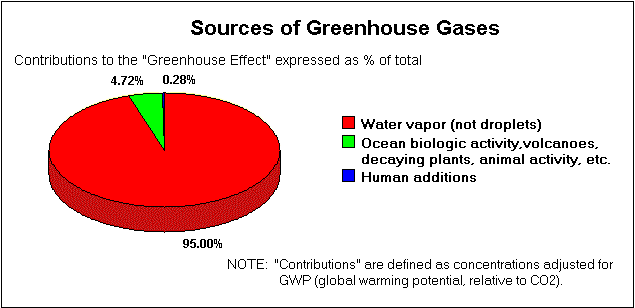
And to close, Crichton made it clear in his book that his opinion is NOT that global warming isn't happening, but that we as a species have no idea if it's happening or not, but our human contributions are surely not the cause of its occurence if it is. To take one of the many arguments from the novel, termites outWEIGH us 1000 to 1 and they release methane gas, a much more potent greenhouse gas than CO2. Here's a 'chilling' look at our human contributions:


Additional Note: When the novel "State of Fear" was in the brainstorming stages, it was going to be an "End of Days"-style book, with natural disasters coming stronger and stronger because of global warming. Crichton does do a lot of research for his books, and soon couldn't fit everything together anymore. It was only then that he changed his book to be about the farce of global warming.

Why is it important to critically analyze the media? - The Final Cut

Those who read the original version can now see how cut down it got on submission:

Approximate Length: 2 min.


In 1939, Hitler started his conquest of the globe. His regime is known as one of the most propagandist ones in history, if not the most. He managed to convince his entire population that Jewish people were evil, inferior, and must be exterminated off the face of the Earth. These people weren't stupid, nor were they simply blind followers; they truly believed that Hitler was doing good for the world; his propaganda had convinced them.

The problem arises from a government that is fully aware of how to manipulate the public, and utilizes, via the media, our perceptual tendencies. For instance, we generally will “cling to first impressions, even if they’re wrong” (Adler, 2006, p.37). The media can use this by first incriminating the cause, and then later leaving it open to public interpretation. For example, the war in Iraq was first announced as a means of controlling weapons of mass destruction, thus implanting an evil perception on the subject. Later, even after no weapons were found, the public still believed that they had at least conquered a great evil (Goodman, 2003). This is circular logic since, the idea of them being a great evil was based on them having said weapons, which were never found.

It is important as a population to understand our own tendencies such that we might be able to pass unbiased judgment of an event. Do I truly back this war? What is the other side of the story? If we continue to ask questions like these, it will become harder for a government to act in a way that does not benefit its people, and conversely, it will become harder for a government to avoid the true demands of the people, who have become more vocal against a platform that has become somehow transparent.


Works Cited:

Adler, Ronald B. and George Rodman. Understanding Human Communication, 9th ed. New York: Oxford University Press, 2006.

Goodman, Ellen, “Let me see, uh, well, why did we invade Iraq?” Boston Globe 20 May, 2003. 1 Oct., 2006 .

Sunday, October 01, 2006

Why is it important to critically analyze the media? - The Extended Informal Interactive Edition

I wrote the original version of my critical analysis paper without really reading the restrictions, so I had to trim down a lot on submission. The real version will be released tomorrow, but I thought I wouldn't trash the original, since there was a lot I didn't want to take out. Plus, this version had video links! Gold!

Appoximate Length: 25 min.


In 1939, Hitler started his conquest of the globe. His regime is known as one of the most propagandic ones in history, if not the most. He managed to convince his entire population that Jewish people were evil, inferior, and must be exterminated off the face of the Earth. These people weren't stupid, nor were they simply blind followers; they truly believed that Hitler was doing good in the world; his propaganda had convinced them.

Here is a video of Nazi propaganda:


Back in the United States and its allied countries, Germany was being demonized by the media, put out to be all pure evil: tens of millions of evil people that do not deserve to exist. Later in the war, the same treatment was done to the attacking Japanese, making them out to be subhuman, and the general population bought both; truly believing them.

Here is a classic Donald Duck cartoon demonizing the Germans:


There have been countless cases, even since then, but our population is not as naive as it used to be. We can no longer be psyched in to a war like we could be psyched in to a university football match at a pep rally. Today, there are countless opinions on all sides of the ongoing conflicts, and everyone critically analyzes the causes of wars, deciding whether or not they want to back their nation's apparent interests.

Here is a popular Green Day video that represents opposition to the American agenda:


The problem arises from a government that is fully aware of how to manipulate the public, and utilizes, via the media, our perceptual tendencies. For instance, we generally will “cling to first impressions, even if they’re wrong” (Adler, 2006, p.37). The media can use this by first incriminating the cause, and then later leaving it open to public interpretation. For example, the war in Iraq was first announced as a means of controlling weapons of mass destruction, thus implanting an evil perception on the subject. Later, even after no weapons were found, the public still believed that they had at least conquered a great evil (Goodman, 2003). This is circular logic since, the idea of them being a great evil was based on them having said weapons, which were never found.

Here is a video of the Daily Show, where Jon Stewart uncovers that Iraq had "nothin" to do with 9/11. It's 3 minutes in, but watch the whole thing; it's too funny not to.


(modified 10/11/06, as the original video was removed from YouTube)

It is important as a population to never follow, and always question the vague statements laid on us in the media. Do I truly back this war? What is the other side of the story? If we continue to ask questions like this, it will become harder for a government to act in a way that does not benefit its people, and conversely, it will become harder for a government to avoid the true demands of the people, who have become more vocal against a platform that has become somehow transparent.


Works Cited:

Adler, Ronald B. and George Rodman. Understanding Human Communication, 9th ed. New York: Oxford University Press, 2006.

Goodman, Ellen, “Let me see, uh, well, why did we invade Iraq?” Boston Globe 20 May, 2003. 1 Oct., 2006 .

All attached videos are automatically linked to their sources.