Sorry in advance for maybe using this blog in ways that are not directly for Communication Studies, but I couldn't help myself. This is an issue anyone close to me knows I make a lot, but here we go again...
A Response to Alex Sévigny on Fact-Influence Confusion
In Monday's lecture, Alex spoke of 'Fact-Influence Confusion', that is when something is taken to be true just because it is from a popular, or influential, source. As an example, he took Michael Crichton's campaign against global warming theorists, and how he has since gathered a following.
For most people to come out and say something like that would be a fair example of influence becoming fact, but Michael Crichton has the facts to back his 'opinion' up. I strongly recommend you read "State of Fear", a heavily footnoted and referenced novel on the issue by Crichton. I can personally tell you that I was fully convinced, and can now find fault whenever the issue is brought up in positive light.
Now, there are debates on the Internet about the issues Crichton calls in to question, but what stands out for me is what's behind the message: Michael Crichton. Crichton is easily one of the most famous authors around today; he's written some 20 novels, of which more than half have been translated in to movies and miniseries. He is also the creator of the medical drama "E.R.", and, here's the kicker, he has a dinosaur named after him. No joke, that is the Crichtonsaurus bohlini.
So why does this make him more credible? Simply put, he has nothing to gain from stirring up controversy. He's not an author struggling to breakthrough, he's not an author in need of money. He is wealthy beyond coercion from any source. "Big Oil" can't have him in their pocket; their pocket simply isn't large enough to hold him.
On the other side of the coin, we have to good, "Save the Earth" groups who study climate change as their life. Now you're wondering, where am I going with this? Surely a group that studies climate change as their life would know more about it than a sci-fi writer who will be on to a new topic come his next novel (entitled "Next", out later this year, if anyone's interested). This is where we have to remember that the group gets their paycheque from their studies. Their charity organization is still a business that DEPENDS on donations and lawsuits to gain profit. This is a cold way of looking a group with such good intentions, but in the end, it's the truth. Any studies they do are naturally going to be skewed to back their cause, because if they proved beyond any doubt that global warming was not occurring (or that we had nothing to do with it), they pretty much have to pack up (not to mention face the outrage of the donaters and lawsuit victims).
Here's a what if: Homer Simpson becomes smart and (accidentally) proves there's no God. How will Ned Flanders take it? What would be his first reaction?
Out comes the lighter!
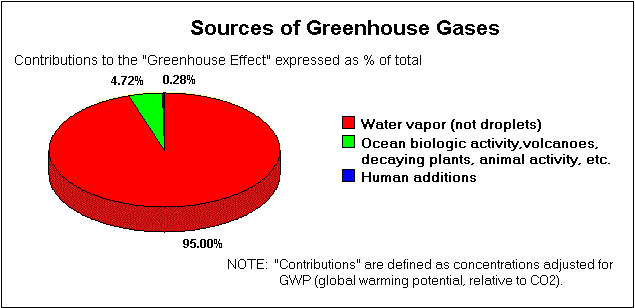
And to close, Crichton made it clear in his book that his opinion is NOT that global warming isn't happening, but that we as a species have no idea if it's happening or not, but our human contributions are surely not the cause of its occurence if it is. To take one of the many arguments from the novel, termites outWEIGH us 1000 to 1 and they release methane gas, a much more potent greenhouse gas than CO2. Here's a 'chilling' look at our human contributions:
Additional Note: When the novel "State of Fear" was in the brainstorming stages, it was going to be an "End of Days"-style book, with natural disasters coming stronger and stronger because of global warming. Crichton does do a lot of research for his books, and soon couldn't fit everything together anymore. It was only then that he changed his book to be about the farce of global warming.
posted by atsikouras at 6:50 PM


0 Comments:
Post a Comment
<< Home